Asparagaceae · ARCHIVBLATT
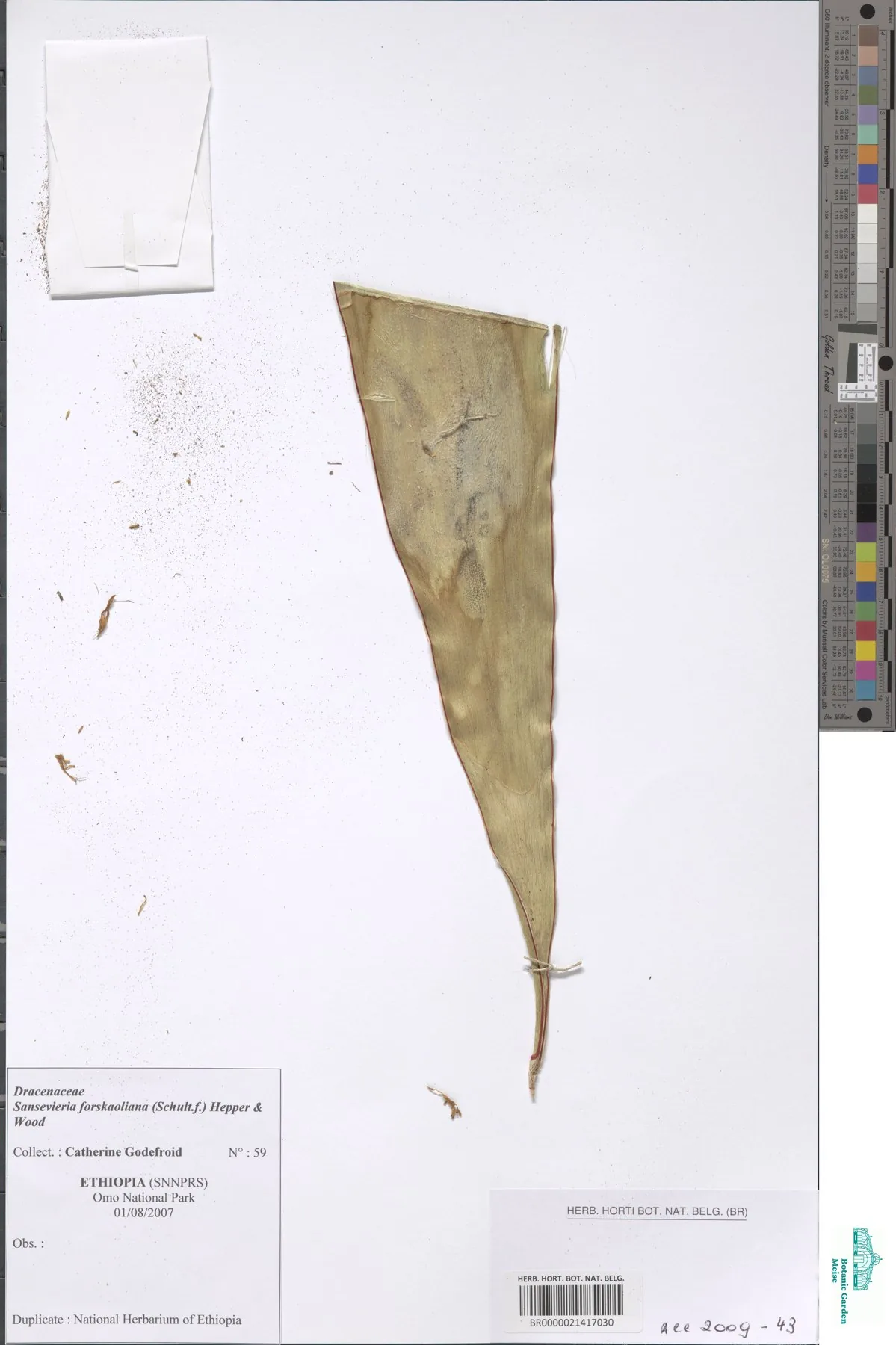
Sansevieria
forskaoliana
Akzeptierter Name nach Kew:Accepted name according to Kew: Dracaena forskaliana
01 / VERBREITUNGDISTRIBUTION
Natürliche VerbreitungNatural distribution
Nach Kew WCVP: NE. & E. Trop. Africa to SW. Arabian Pen..According to Kew WCVP: NE. & E. Trop. Africa to SW. Arabian Pen..
02 / ERKENNUNGCHARACTERS
Wuchs und MerkmaleHabit and characters
Arbeitsdiagnose nach Mansfeld (2013) und Webb & Newton (2022): Acaulescent; flat / broad; rough leaf surface; transverse banding or mottling; rhizomatous growth. Blattgestalt: flat / broad; Oberfläche: rough; Blütenstand: simple / unbranched.Working diagnosis based on Mansfeld (2013) and Webb & Newton (2022): Acaulescent; flat / broad; rough leaf surface; transverse banding or mottling; rhizomatous growth. Leaf form: flat / broad; surface: rough; inflorescence: simple / unbranched.
03 / LEBENSRAUM UND KULTURHABITAT AND CULTIVATION
Reading the habitat
- Mikrohabitat & GeologieMicrohabitat & geology
- Typuslokalität: Al Hadiyah, Yemen; ungefähr 1175 m Höhe. Diese Angabe bezeichnet die Herkunft des nomenklatorischen Typus und noch keine vollständige Beschreibung des Lebensraums.Type locality: Al Hadiyah, Yemen; approximately 1175 m elevation. This records the origin of the nomenclatural type, not yet a complete habitat description.
- Klima / StandorttypClimate / habitat type
- Wüste oder Trockengebüschdesert or dry shrubland
- Klima am dokumentierten FundortClimate at the documented locality
- Zaid II, Yemen: Jemen: arid bis semiarid; Hochlagen sind gegenüber dem Tiefland deutlich gemäßigter, mit episodischen, überwiegend sommerlichen Regenfällen. Regional etwa 150–500 mm/Jahr und je nach Höhe 18–28 °C.
- Zaid II, Yemen: Yemen: arid to semi-arid; highlands are markedly cooler than lowlands, with episodic mainly summer rainfall. Regionally about 150–500 mm/year and 18–28 °C depending on elevation.
Die Werte sind regionale Orientierungsbereiche, keine Messungen am Sammelpunkt. Grundlage sind WorldClim 2.1 (1970–2000) und die Köppen-Geiger-Karte (1980–2016); Mikrohabitate können deutlich abweichen.Values are regional orientation ranges, not measurements at the collection point. They are based on WorldClim 2.1 (1970–2000) and the Köppen-Geiger map (1980–2016); microsites may differ substantially.
- Cultivation inference
- Die großräumige Biomeinordnung spricht als vorsichtiger Ausgangspunkt für einen hellen, warmen Stand, ein rasch drainierendes Substrat und deutliches Abtrocknen zwischen den Wassergaben. Mikrohabitat, Gestein und jahreszeitlicher Niederschlag sind für diese Art in der ausgewerteten Literatur nicht belastbar genug aufgelöst; die Kulturfolgerung bleibt entsprechend vorsichtig.The broad biome classification suggests, as a cautious starting point, a bright warm position, rapidly draining substrate and clear drying between waterings. Microhabitat, geology and seasonal rainfall are not resolved reliably enough for this species in the literature evaluated; the cultivation inference therefore remains cautious.
- Status of information
- LITERATURBELEGTER LEBENSRAUM · KULTURFOLGERUNG ABGELEITETHABITAT DOCUMENTED IN LITERATURE · CULTIVATION INFERRED
04 / ETHNOBOTANIKETHNOBOTANY
Überlieferte NutzungTraditional use
In den für dieses Porträt verwendeten Quellen ist keine eindeutig artspezifische traditionelle Nutzung belegt. Angaben zu verwandten Arten werden nicht übertragen.The sources used for this profile do not document an unambiguous species-specific traditional use. Uses reported for related species are not transferred.
05 / SAMMLUNGCOLLECTION
Collection record
Dokumentierte Zugänge:Documented accessions:
- Sansevieria forskaoliana — Zaid II, Yemen
06 / QUELLENSOURCES
Literature used
- Govaerts, R. et al.: World Checklist of Vascular Plants, Royal Botanic Gardens, Kew.
- Mansfeld, P. A. (2013): Die Gattung Sansevieria.
- Webb, R. H. & Newton, L. E. (2022): The Genus Sansevieria.
- Fick, S. E. & Hijmans, R. J. (2017): WorldClim 2: new 1-km spatial resolution climate surfaces for global land areas. International Journal of Climatology 37: 4302–4315.
- Beck, H. E. et al. (2018): Present and future Köppen-Geiger climate classification maps at 1-km resolution. Scientific Data 5: 180214.