Asphodelaceae · ARCHIVBLATT
Haworthiopsis
attenuata var. glabrata
Akzeptierter Name nach Kew:Accepted name according to Kew: Haworthiopsis attenuata var. glabrata
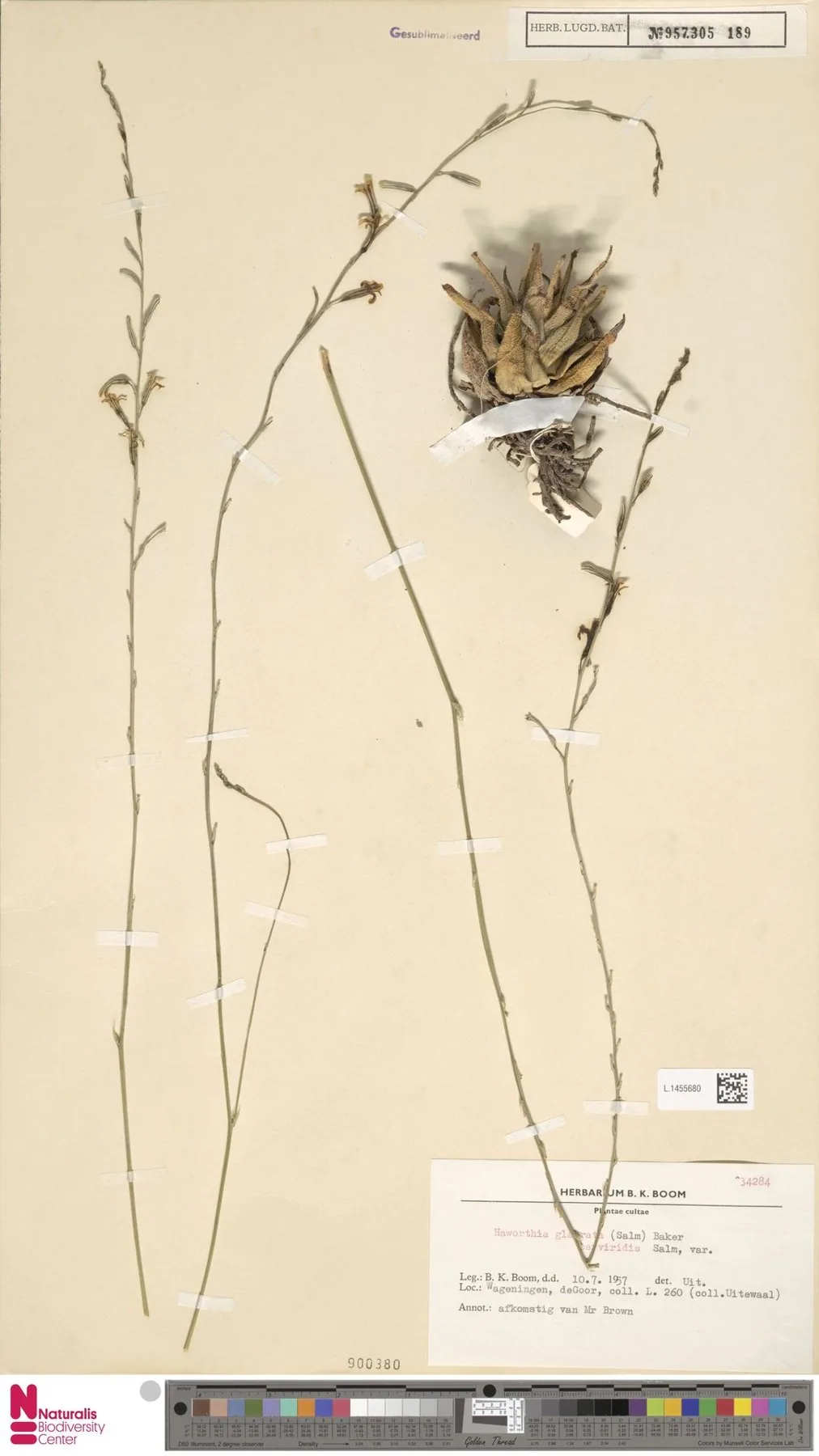
01 / VERBREITUNGDISTRIBUTION
Natürliche VerbreitungNatural distribution
Nach Kew WCVP: SE. Cape Prov. (Butterworth Distr.).According to Kew WCVP: SE. Cape Prov. (Butterworth Distr.).
02 / ERKENNUNGCHARACTERS
Wuchs und MerkmaleHabit and characters
Kompakte Rosettenpflanze mit festen, undurchsichtigen Blättern; Höcker, Kiele, Randzähne und die Anordnung der Rosetten sind wichtige Merkmale innerhalb der Gattung. Die artsichere Bestimmung erfordert den Vergleich der vollständigen Blatt- und Blütenmerkmale mit der Spezialliteratur.A compact rosette plant with firm, opaque leaves; tubercles, keels, marginal teeth and rosette arrangement are important characters within the genus. Reliable species identification requires comparison of the complete leaf and flower characters with specialist literature.
03 / LEBENSRAUM UND KULTURHABITAT AND CULTIVATION
Reading the habitat
- Mikrohabitat & GeologieMicrohabitat & geology
- Haworthiopsis-Arten besiedeln im südlichen Afrika überwiegend steinige bis felsige Kleinstandorte, häufig zwischen Gestein oder im Schutz niedriger Gehölze. Exposition, Gestein und Niederschlagsrhythmus unterscheiden sich zwischen den Arten und werden zusammen mit der angegebenen Verbreitung bewertet.Haworthiopsis species in southern Africa mainly occupy stony to rocky microsites, often among rocks or sheltered by low woody vegetation. Exposure, geology and rainfall rhythm differ among species and are assessed together with the stated distribution.
- Klima / StandorttypClimate / habitat type
- subtropisches Biomsubtropical
- Klima am dokumentierten FundortClimate at the documented locality
- Bashee River, PVB4400: Süd- und Ostkap: warmgemäßigtes bis subtropisches Übergangsklima mit vergleichsweise ganzjährigem Niederschlag und wiederkehrenden Trockenphasen; regional grob 400–800 mm/Jahr und 15–21 °C.
- Bashee River, PVB4400: Southern and Eastern Cape: warm-temperate to subtropical transition climate with comparatively year-round rainfall and recurring dry periods; regionally about 400–800 mm/year and 15–21 °C.
Die Werte sind regionale Orientierungsbereiche, keine Messungen am Sammelpunkt. Grundlage sind WorldClim 2.1 (1970–2000) und die Köppen-Geiger-Karte (1980–2016); Mikrohabitate können deutlich abweichen.Values are regional orientation ranges, not measurements at the collection point. They are based on WorldClim 2.1 (1970–2000) and the Köppen-Geiger map (1980–2016); microsites may differ substantially.
- Cultivation inference
- Die meist felsigen, kleinräumig beschatteten Standorte sprechen für helles, aber vor harter Mittagssonne geschütztes Licht, sehr gute Drainage und zurückhaltendes Gießen. Dauerhaft nasses Substrat, besonders bei kühlen Temperaturen, ist zu vermeiden; artspezifische Abweichungen bleiben zu beachten.The commonly rocky, locally shaded habitats indicate bright light protected from harsh midday sun, excellent drainage and restrained watering. Permanently wet substrate, especially in cool conditions, should be avoided; species-level differences still apply.
- Status of information
- LITERATURBELEGTER LEBENSRAUM · KULTURFOLGERUNG ABGELEITETHABITAT DOCUMENTED IN LITERATURE · CULTIVATION INFERRED
04 / ETHNOBOTANIKETHNOBOTANY
Überlieferte NutzungTraditional use
Die herangezogenen taxonomischen Werke dokumentieren für diese Art keine eindeutig artspezifische traditionelle Nutzung. Allgemeine Angaben zu anderen Aloenverwandten werden nicht auf dieses Taxon übertragen.The taxonomic works consulted do not document an unambiguous species-specific traditional use for this species. General uses reported for other alooid plants are not transferred to this taxon.
05 / SAMMLUNGCOLLECTION
Collection record
Dokumentierte Zugänge:Documented accessions:
- Haworthiopsis attenuata — var. glabrata — Bashee River, PVB4400
06 / QUELLENSOURCES
Literature used
- Govaerts, R. et al.: World Checklist of Vascular Plants, Royal Botanic Gardens, Kew.
- Breuer, I. & Marks, G. B.: Haworthia, Haworthiopsis and Tulista.
- Fick, S. E. & Hijmans, R. J. (2017): WorldClim 2: new 1-km spatial resolution climate surfaces for global land areas. International Journal of Climatology 37: 4302–4315.
- Beck, H. E. et al. (2018): Present and future Köppen-Geiger climate classification maps at 1-km resolution. Scientific Data 5: 180214.