Lamiaceae · ARCHIVBLATT
Coleus
burorum
Akzeptierter Name nach Kew:Accepted name according to Kew: Coleus burorum
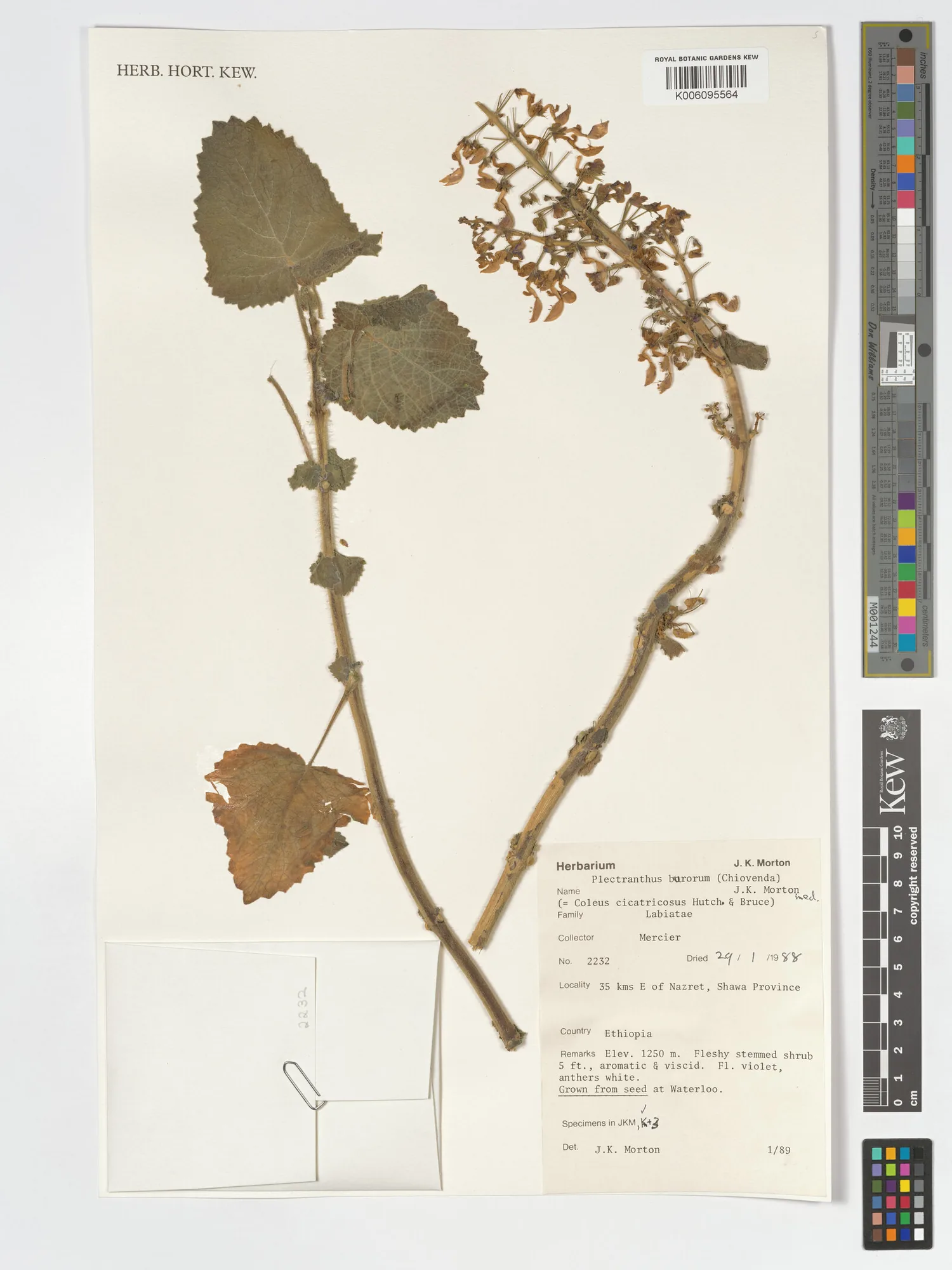
Synonym: Plectranthus burorum (Chiov.) J.K.Morton; Coleus cicatricosus Hutch. & E.A.BruceSynonym: Plectranthus burorum (Chiov.) J.K.Morton; Coleus cicatricosus Hutch. & E.A.Bruce
01 / VERBREITUNGDISTRIBUTION
Natürliche VerbreitungNatural distribution
Nach Kew WCVP: Ethiopia to Somalia, Yemen.According to Kew WCVP: Ethiopia to Somalia, Yemen.
02 / ERKENNUNGCHARACTERS
Wuchs und MerkmaleHabit and characters
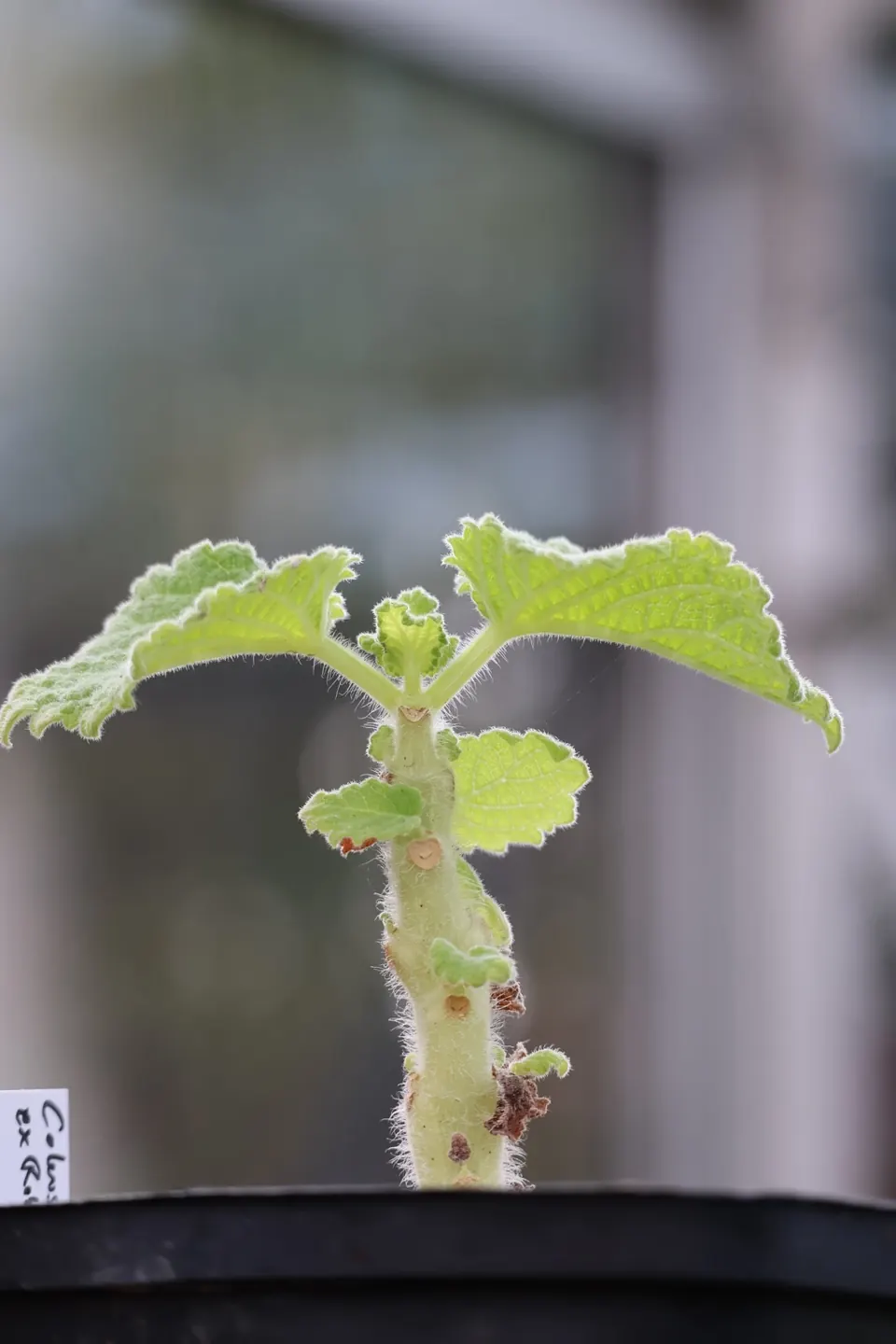
Aromatische, ausdauernde bis halbstrauchige und deutlich sukkulente Pflanze mit verzweigtem, teils niederliegendem Wuchs. Charakteristisch sind fleischige, rundlich gekerbte Blätter sowie blau- bis violettfarbene Blüten; ältere Triebe können deutliche Blattnarben tragen. Die Art kann zur Blütezeit stark entlaubt sein, weshalb vegetative Pflanzen allein vorsichtig zu bestimmen sind.An aromatic perennial to subshrub with a distinctly succulent, branched and partly procumbent habit. Fleshy crenate leaves, blue to violet flowers and conspicuous leaf scars on older stems are characteristic. Plants may be markedly leafless at flowering, so vegetative material alone should be identified cautiously.
03 / LEBENSRAUM UND KULTURHABITAT AND CULTIVATION
Reading the habitat
- Mikrohabitat & GeologieMicrohabitat & geology
- Die somalische Flora führt die Art für Somalia; der Typus wurde in Buschland bei Bur Budulca im Süden des Landes gesammelt. Weitere Vorkommen liegen in Äthiopien und im Jemen. Die belegte Buschlandherkunft spricht für einen offenen bis licht beschatteten, saisonal trockenen Standort.The Somali flora records the species from Somalia; the type was collected in bushland at Bur Budulca in the south of the country. Further occurrences are known from Ethiopia and Yemen. The documented bushland origin indicates an open to lightly shaded, seasonally dry habitat.
- Klima / StandorttypClimate / habitat type
- saisonal trockenes Buschlandseasonally dry bushland
- Klima am dokumentierten FundortClimate at the documented locality
- Metahara, Ethiopia: Metahara im äthiopischen Rift: heißes semiarides Klima mit langen Trockenphasen und zwei saisonalen Regenmaxima; grob 400–650 mm/Jahr und 24–29 °C.
- Metahara, Ethiopia: Metahara in the Ethiopian Rift: hot semi-arid climate with long dry periods and two seasonal rainfall peaks; roughly 400–650 mm/year and 24–29 °C.
Die Werte sind regionale Orientierungsbereiche, keine Messungen am Sammelpunkt. Grundlage sind WorldClim 2.1 (1970–2000) und die Köppen-Geiger-Karte (1980–2016); Mikrohabitate können deutlich abweichen.Values are regional orientation ranges, not measurements at the collection point. They are based on WorldClim 2.1 (1970–2000) and the Köppen-Geiger map (1980–2016); microsites may differ substantially.
- Cultivation inference
- Aus dem sukkulenten Wuchs und dem Buschlandstandort lässt sich ein warmer, heller Platz mit sehr guter Drainage ableiten. Während des Austriebs mäßig gießen und anschließend gut abtrocknen lassen; eine blattärmere Phase zur Blüte ist nicht automatisch ein Schadbild.Its succulent habit and bushland habitat suggest warm, bright conditions with excellent drainage. Water moderately during active growth and allow the substrate to dry well; a leaf-poor phase at flowering is not necessarily a sign of damage.
- Status of information
- ARTMERKMALE UND HERKUNFT AUS DER FLORA · KULTUR ABGELEITETCHARACTERS AND ORIGIN FROM THE FLORA · CULTIVATION INFERRED
04 / ETHNOBOTANIKETHNOBOTANY
Überlieferte NutzungTraditional use
In den für dieses Porträt verwendeten Quellen ist keine eindeutig artspezifische traditionelle Nutzung belegt. Angaben zu verwandten Arten werden nicht übertragen.The sources used for this profile do not document an unambiguous species-specific traditional use. Uses reported for related species are not transferred.
05 / SAMMLUNGCOLLECTION
Collection record
Dokumentierte Herkunft: Metahara, Äthiopien.Documented origin: Metahara, Ethiopia.
DOKUMENTIERTE ZUGÄNGEDOCUMENTED ACCESSIONSDokumentierte Zugänge:Documented accessions:
- Coleus burorum — Metahara, Ethiopia
06 / QUELLENSOURCES
Literature used
- Govaerts, R. et al.: World Checklist of Vascular Plants, Royal Botanic Gardens, Kew.
- Paton, A. J. et al. (2019): Nomenclatural changes in Coleus and Plectranthus (Lamiaceae). PhytoKeys 129: 1–158.
- Thulin, M. (Hrsg.) (2006): Flora of Somalia, Band 3; Behandlung unter Plectranthus burorum.
- Fick, S. E. & Hijmans, R. J. (2017): WorldClim 2: new 1-km spatial resolution climate surfaces for global land areas. International Journal of Climatology 37: 4302–4315.
- Beck, H. E. et al. (2018): Present and future Köppen-Geiger climate classification maps at 1-km resolution. Scientific Data 5: 180214.
07 / EIGENE AUFNAHMENCULTIVATED PLANTS
Pflanzen in KulturPlants in cultivation